Legislation to secure essential due process for Correctional Officers - enacted
Sponsored by Representative Witte and Senator Limmer Updates the Correctional Officers Discipline Procedures Act (CODPA).
2026 Enacted – Correctional Officers Bill of Rights
Correctional Officers Due Process Protections, Amendments to Minn. Stat. §241.026 (CODPA) & 626.89 (PODPA)
Purpose
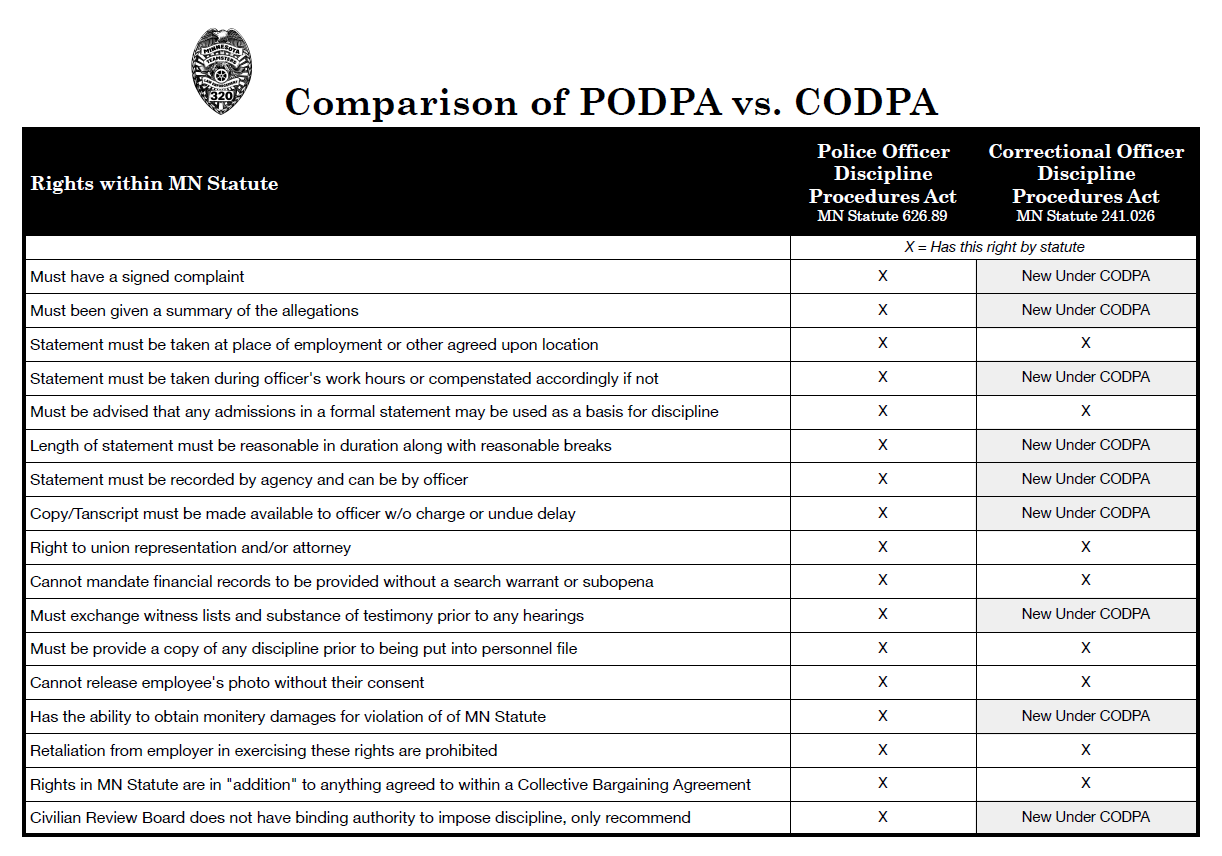
The Correctional Officers Discipline Procedures Act (CODPA) provides non-licensed correctional officers with core due process protections already afforded to licensed peace officers during disciplinary investigations under Minnesota law.
The new law protects correctional officers
Correctional officers are non-licensed public safety professionals who work in secure custodial settings, often alongside licensed peace officers.
The new COPDA establishes consistent standards promotes fairness, transparency, and uniform application of disciplinary procedures across Minnesota’s public safety system.
 Primary Changes to CODPA (§241.026)
The new law incorporates key protections including:
- Written complaint before a formal statement
- Summary of allegations prior to questioning
- Access to investigative reports and witness information
- Recorded questioning sessions
- Right to union representation and/or legal counsel
- Reasonable session duration and compensation protections
- Protection against retaliation
- Civil remedy for statutory violations
Clarification of “Formal Statement”
The statute aligns the definition of “formal statement” in CODPA and PODPA.
A “formal statement” means questioning conducted to obtain information that may be used as a basis for discipline or as evidence in a disciplinary proceeding.
This clarification ensures consistent application of statutory protections when questioning may result in discipline.
Structural Approach
The updated CODPA language was intentionally structured to achieve stakeholder consensus and ensure broad support for the statutory changes.
By maintaining correctional officers within Minn. Stat. §241.026 rather than relocating them into §626.89 and aligning definitions across the statutes, the proposal avoids jurisdictional conflict, ensures uniform protections for state and local correctional officers, and preserves a clear statutory framework.
Bottom Line
The new CODPA ensures non-licensed correctional officers receive the same core due process protections already provided to licensed peace officers and clearly defines when those protections apply.